|
The Critters |
|
Since the time our ancestors first unearthed or tripped over a bone that obviously did not belong to any of the creatures around them, we humanoids have sought to make sense of them. It is now believed that many of the beasts of legend were born of such discoveries. The giants and cyclops and griffin, to name a few -- cyclops in particular: a mammoth's skull with its tiny eye sockets and huge trunk hole has an uncanny resemblance to a one-eyed giant.(1) Yes, thus legends are born.
If a few observers took the next step to speculate these bones belonged to natural creatures that had died out, it was left to Georges Cuvier(2) to establish that extinction was a fact. His works on comparative anatomy between extinct and existing species laid the groundwork for men like Sir Richard Owen(3) who coined the term "dinosauria" or "terrible lizard". Paleontology was finally up and running as science. Now it was left to the field paleontologists and their sponsors to begin collecting bones, comparing them to other bones, and naming them.
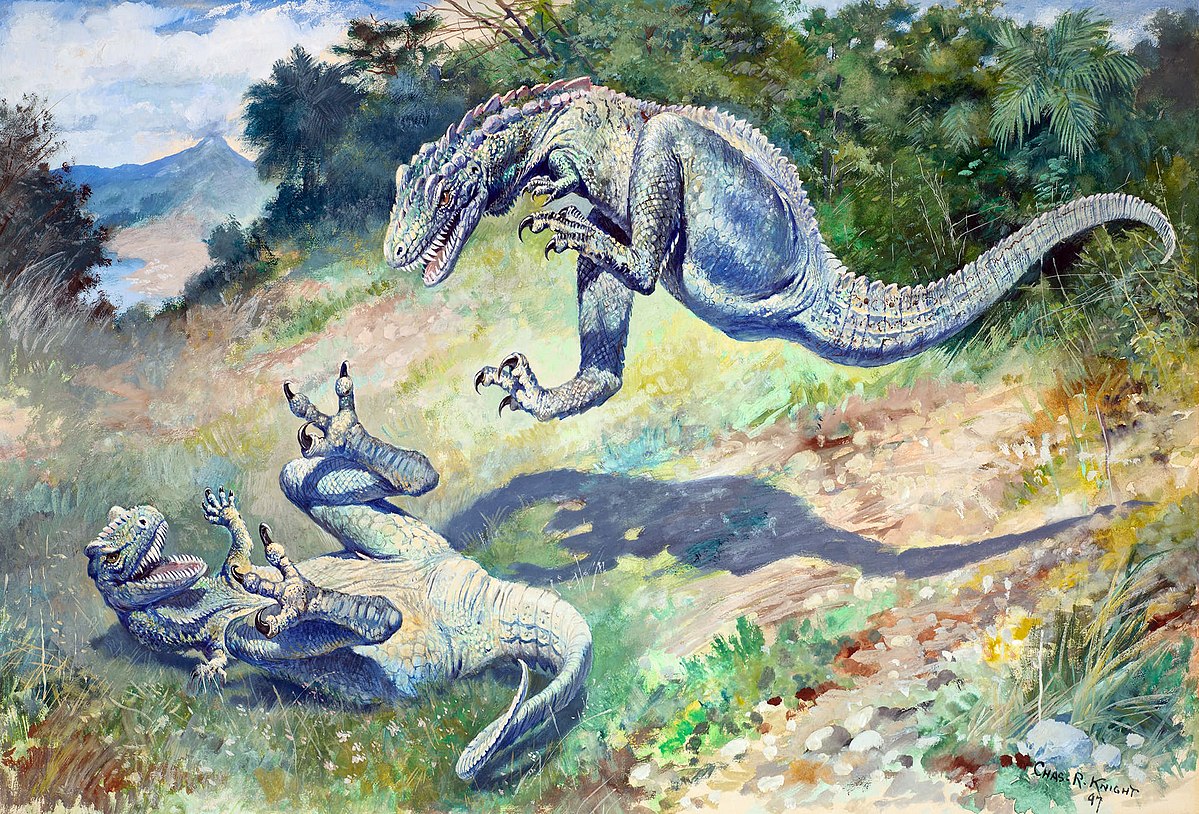
As this was happening, the critters caught the imagination of artists. Benjamin Waterhouse Hawkins(4) worked with Sir Richard Owen to create the first set of dinosaur sculptures for London's Crystal Palace (1851-1853) then went on to use his expertise to mount the first complete dinosaur skelton, a hadrosaurus, in 1868. Other artists quickly followed, probably the most famous being Charles Knight(5) whose works, though outdated, still grace many of our finer museums.
The work displayed above is one of Knight's and was chosen for this section because of its depiction of extremely active dinosaurs, i.e., dinosaurs acting more like more birds than the traditional plodding behomoths depicted by most paleoartists (including Knight) for the next nine decades. This view of the big boys has been pretty much debunked since Dr. Robert Bakker's The Dinosaur Heresies (1986) which contended that these creatures were the warm-blooded ancestors of birds, something long theorized but never popularized before Dr. Bakker(6). Although the theory of warm-bloodness (endothermic) is still being contested, few any longer question the bird link.
Why the concentration on dinosaurs? Ask any seven-year-old. The huge extinct creatures do not only capture the imagination, they invade it. Most seven-year-olds can spout more multisyllable latinized dinosaur names than they can name edible vegetables. This fascination fades for most, but for a few of us the lure never dims -- and, maybe for more than a few: witness the Jurassic Park books and movies and the numerous Discover Channel dinosaur series and specials.
Dinosaurs, however, are not the whole story and never were. Cuvier's first work was with Mastodons. Other scientists have specialized in other areas and formulated theories dating back to the very beginning of life on earth and extending into the very present with those seeking to find or recreate specific species thought to be extinct. All of these theories find their roots in the fossil record -- i.e., the full accumulation of bones and rock impressions and animal trackways. Also let us not forget the plants and other life forms that populated the ancient world and give us a broader picture of what that world looked like and how its inhabitants interacted.
This is, after all, the study of our own deep past, how we came to be, and what well might be our future. It is comforting to remember that life may seem fragile but has somehow survived for at least a billion years through climatic extremes we've not experienced. It also behooves us to remember that we as a species will someday go extinct ourselves to be studied by some future paleontologists who, whatever he, she or it is, is not a homo sapiens sapiens.
Citations:
- Mayell, Hillary, "Cyclops Myth Spurred by 'One-Eyed' Fossils?", National Geographic, https://www.nationalgeographic.com/science/2003/02/news-deinotherium-fossils-crete-mythology-paleontology/#close
- Georges Cuvier, Check under JM's Diggers. Also check out: https://en.wikipedia.org/wiki/Georges_Cuvier
- Sir Richard Owen, Check under JM's Diggers. Also check out: https://en.wikipedia.org/wiki/Richard_Owen
- Benjamin Waterhouse Hawkins, Check under JM's Diggers. Also check out: https://en.wikipedia.org/wiki/Benjamin_Waterhouse_Hawkins
- Charles Knight, "Check under JM's Diggers. Also check out: https://en.wikipedia.org/wiki/Charles_R._Knight
- Dr. Robert Bakker, Check under JM's Diggers. Also check out: https://en.wikipedia.org/wiki/Robert_T._Bakker
|
|
|
|