|
Deep Time |
|
Earth formed approx. 4.54 billion years (give or take 50 million years or so). Fossilized microbes have been found in Greenland rocks dated
to 3.8 billion years ago (BYA). 2.1 BYA the first cyanobacteria began emitting oxygen, setting the stage for an oxygenated planet. 900 million years ago
(MYA) the first, simple multi-celled organisms appeared. 540 MYA saw the so-called Cambrian Explosion when animals with skeletons and vertebra first
appeared as did the first mollusks, corals and a wide variety of soft body forms. Some plants and animals began leaving the ocean and populating the land areas.
400 MYA the first four-footed creatures walked onto land and, soon after, appeared the first amphibians, insects and reptiles. 250 MYA saw the first dinosaurs.
200 MYA the first mammals appeared.(2)
Our immediate ancestors, the primates, first showed up approx. 70 MYA and some survived the Chicxulub Extinction
event of 66 MYA when most other life forms did not. The homo genus appeared 2.5 MYA and our own species made an entrance about 800,000 years ago.(3)
Gobekli Tepe, the oldest known man-made monumental site, dates to 12,000 years ago.(4)
British forebears began constructing Stonehenge approx. 5200 years ago.(5)
4600 years ago the Egyptians built the Great Pyramid of Giza....(6)
In short, we're johnny-come-latelies by any standard. Most of us know little about our personal ancestry past our grandparents, information dating back 100 years or so.
Those of us interested in history may feel comfortable with timeframes of a couple hundred or even a couple thousand of years, but what about 1000 x 1000 years, i.e., a
million years or 1000 times that, i.e., one billion? The Rockies have risen, eroded and risen again at least 4 times in a third of that period.(7)
Think of that. 320 MYA
the Rockies rose to height greater than today's Himalayas, eroded completely then rose and eroded 2 more times before they rose again to their current height. Since those first
Rockies rose, the very first dinosaurs appeared, evolved into dominance during the Triassic and ruled through the Jurassic and Cretaceous for approx. 134 million years before an
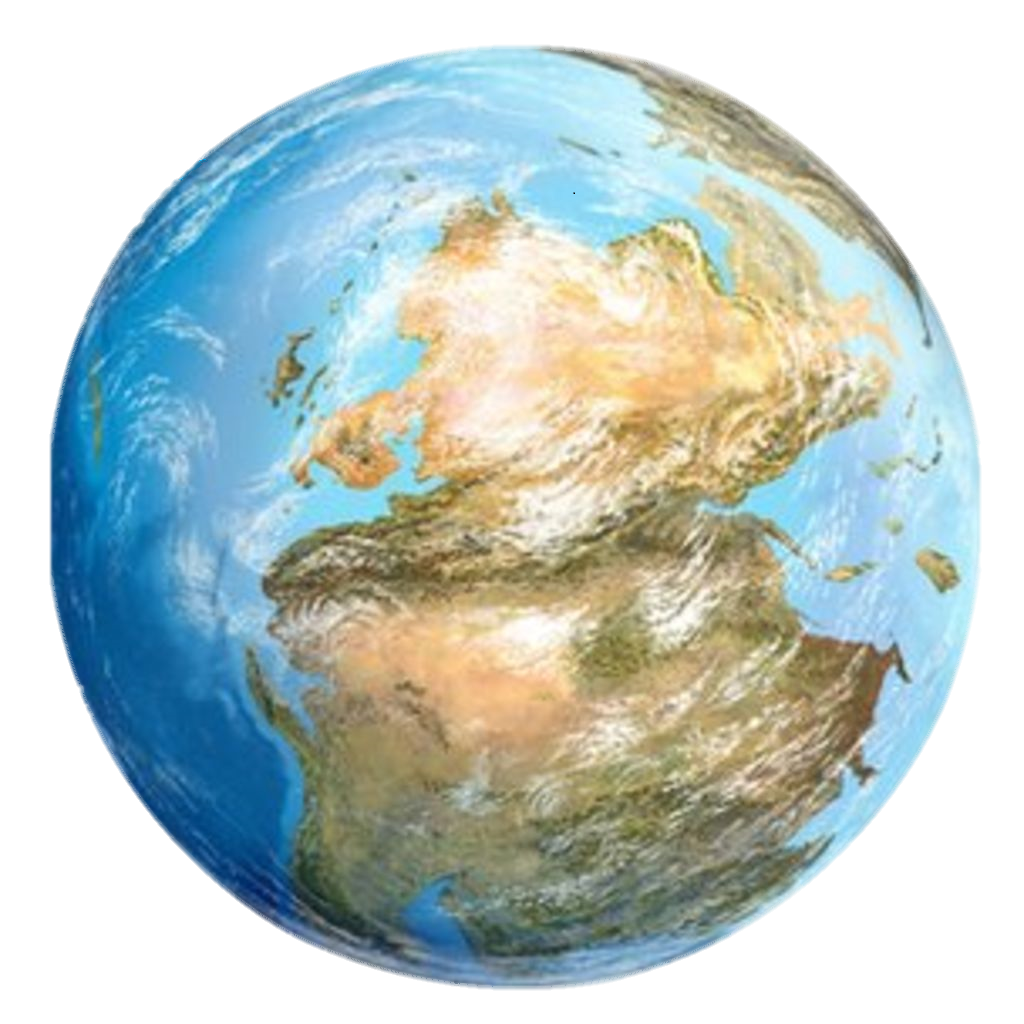
asteroid cut short their dynasty...and during this time Pangaea (the supercontinent pictured above) formed and separated into something recognizable as the continents we know today. Think of it.
Think of it. Think of Earth and all of its permutations. Think of an earth covered with ice from pole to pole, Snowball Earth, and an earth with no ice at all. Think of continents moving together then apart and of the
inhabitants of those continents parting from their cousins to return after generations and speciations bringing from both sides the diseases that had evolved in the meantime. Think of the great extinction events (Chicxulub
was not the greatest of them) when Life itself almost died. Think of the many small miracles that created Life in all of its varieties, from the very big to the very small including those tiny but significant events where
a single tiny organism separates into two cells and those two cells stick together; or a single spore drifts onto land and generates; or a single animal walks onto land or takes to the air or picks up a burning branch for protection or warmth....
Deep Time is virtually incomprehensible to most of us. We can cite the numbers, study the timelines, view the models of moving continents and track the development, evolution and extinction of species, genera,
and familia of the life that has populated Earth since its beginning. We can also take it further back to the Big Bang and the start of Time and the formulation of our universe, the formation of the cosmos, and, after many
more billion years, the cool-off of a fairly small world circulating in the third orbit out from it's rather insignificant yellow star...and again, more numbers comprising time periods beyond our ability to comprehend.
Let us accept that we'll probably never comprehend Deep Time except as numbers and time lines and maps. Instead let us appreciate how Deep Time has allowed the evolution of our universe and its stars and planets and our particular
planet's ever-changing climate, ecology and biodiversity.
Citations:
- International Chronostratigraphic Chart v2018/08, International Commission on Stratigraphy, http://www.stratigraphy.org/ICSchart/ChronostratChart2018-08.pdf
- Timeline of Human Evolution Wikipedia, https://en.wikipedia.org/wiki/Timeline_of_human_evolution
- The Evolution and Complete Timeline of Life on Earth, The Human Origin Project,
https://humanoriginproject.com/evolution-and-timeline-of-life-on-earth/
- Timeline of Human Evolution, Wikipedia, https://en.wikipedia.org/wiki/Timeline_of_human_evolution
- Gobekli Tepe, Wikipedia, https://en.wikipedia.org/wiki/Göbekli_Tepe
- Stonehenge, Wikipedia, https://en.wikipedia.org/wiki/Stonehenge
- Great Pyramid of Giza, Wikipedia, https://en.wikipedia.org/wiki/Great_Pyramid_of_Giza
- The Rocky Mountains, Natural History of the Rocky Mountains, University of Colorado, Boulder, http://snobear.colorado.edu/Markw/Mountains/08/ColoradoMtns/rockymtns.asp.html
|
|
|
|